
In bookkeeping, repetitive manual tasks take up valuable time that could be spent growing your firm or supporting clients. That is why we built William AI: Apron’s bookkeeping agent designed to learn like a new team member.
Built directly into your workflow, William finds missing documents in client inboxes, extracts the relevant details, categorises items according to your Chart of Accounts, and auto-publishes them directly to Xero or QuickBooks.
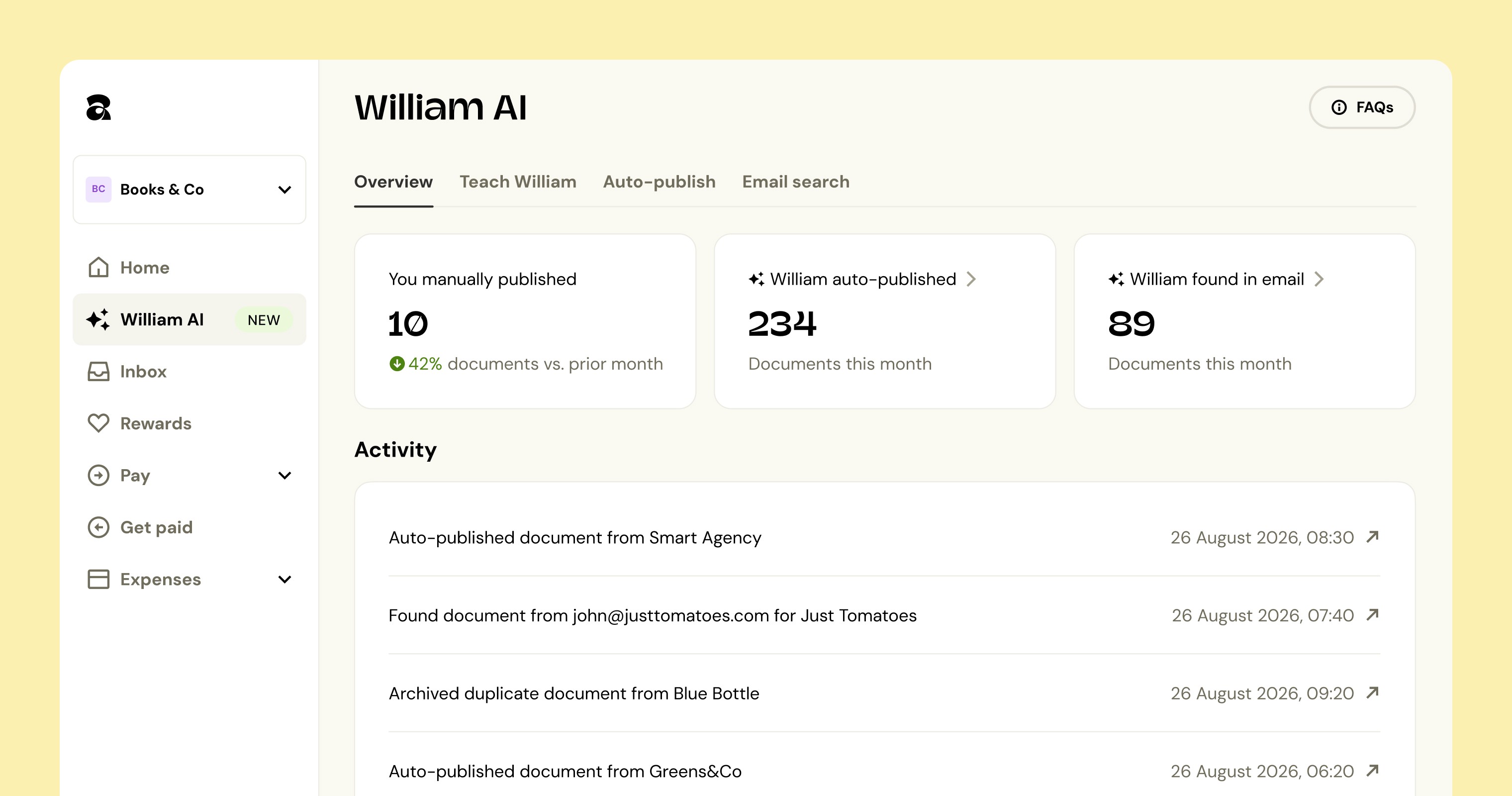
Every action William takes comes with a clear audit trail showing its underlying reasoning and historical references.
Yet, introducing autonomy into financial workflows presents an immediate hurdle: building trust.
The trust paradox in AI
When introducing AI into important bookkeeping workflows, credibility is fragile. As Tallulah Watson, Senior Product Designer at Apron, puts it:
"There’s a really thin line with AI. It really only needs to mess up once for you to think it’s just a black box and that you don’t understand how it works."
If an AI tool makes a silent mistake, users lose confidence in the system entirely. To avoid becoming an unpredictable "black box," an AI agent must know its limits.
True confidence comes from knowing when to act and when to pause and ask for a human review.
What happens when William AI isn’t sure?
Instead of guessing when confidence is low, William AI flags the document and holds it back for human review.
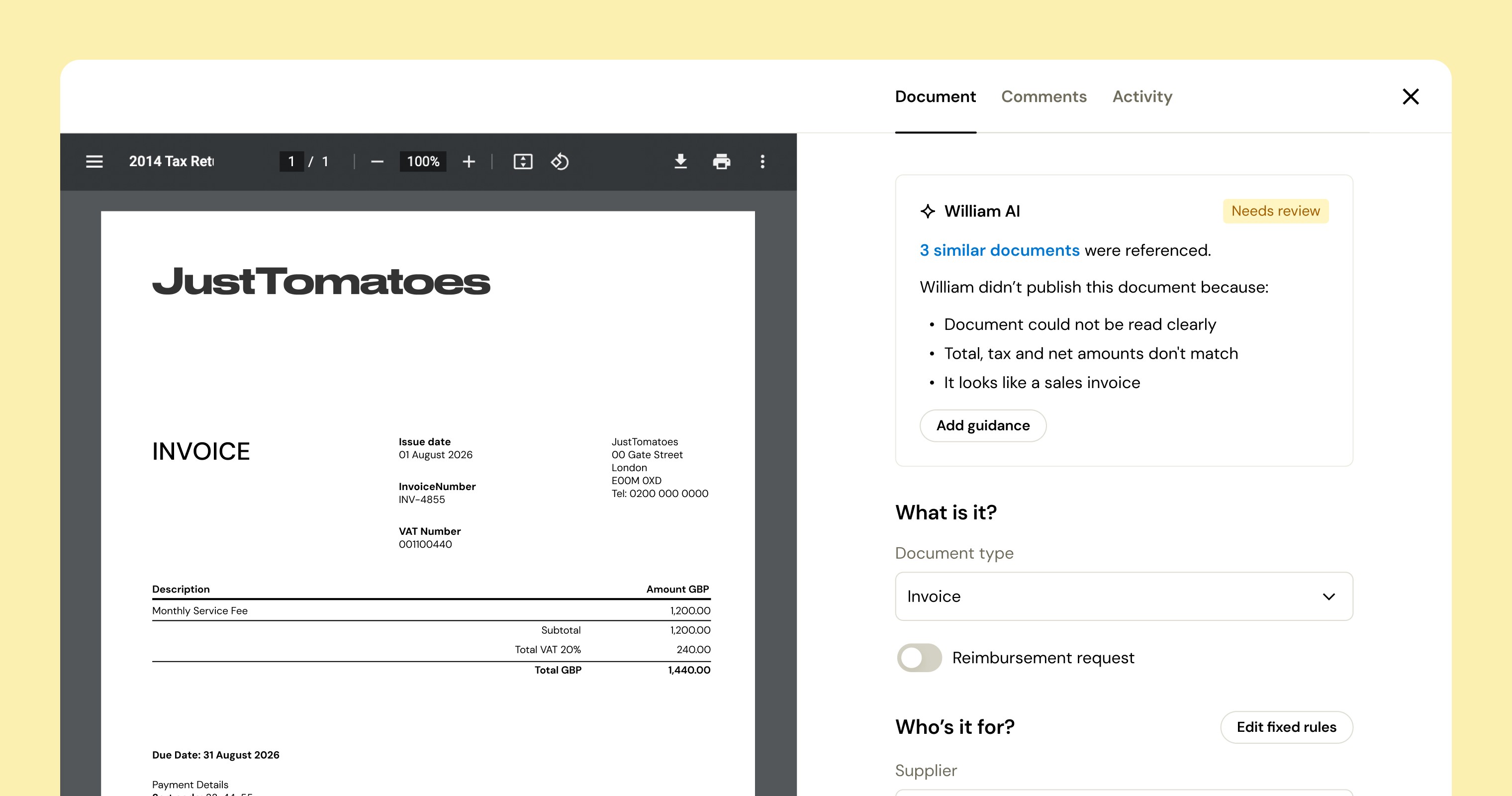
But, rather than displaying cryptic technical errors or jargon, William surfaces the exact reasoning behind its pause in plain English.
There are four core reasons a document gets held back instead of auto-publishing:
No similar documents to reference: William checks historical entries to match patterns. If a vendor or invoice structure is entirely new, it flags the transaction for initial guidance.
Document hard to read: If an uploaded receipt is blurry, poorly scanned, or partially obscured, William stops rather than extracting flawed data.
Looks like a sales invoice or credit note: Unusual document types or reverse-charge items require human verification to ensure correct ledger positioning.
Fields don’t match: If extracted numbers do not reconcile perfectly – such as calculated tax rates failing to match the stated total amount – William asks for a review.
By making these decision boundaries completely transparent, users retain full oversight without having to double-check every single transaction.
Design restraint powered by data
Holding documents back might sound like a conservative approach, but this intentional restraint delivers maximum efficiency where it counts.
Matvey Dolgadrov, Product Manager for William AI, explains the architecture behind this reliability:
"We have quite a sophisticated in-house machine learning model, a set of guardrails, maybe 20 plus validations. We don't want to mess up. Now auto-publish handles roughly half of all documents that come through and of those documents, there's a 99% precision rate."
By pairing deep machine learning with rigorous guardrails, William automates half of your document processing volume while maintaining near-perfect accuracy.
Better to explain than to guess
Building AI for accountants and bookkeepers requires a clear design philosophy: it is always better to hold a document back and explain why than to guess and risk losing trust.
As Tallulah highlights, the ultimate goal is “trying to make it as simple and clear as possible, so it just felt like a no-brainer... almost intuitive to use."
When AI transparently explains its boundaries, it transforms from an unpredictable black box into a reliable digital team member you can trust.