To 99% accuracy in six weeks: Building William AI
Here is how we scaled William AI in a month and a half

When building William AI, Apron’s bookkeeping agent, we set out to deliver speed and precision simultaneously. In just six weeks, our product and engineering teams took William’s core accuracy to near-perfect precision, transforming an ambitious prototype into a reliable, everyday digital team member.
William’s journey to 99.9% precision
When we began testing auto-publish functionality late last year, we knew that total document processing accuracy is non-negotiable. Anything below a near-perfect success rate made automated publishing a complete non-starter.
As Matvey Dolgadrov, Product Manager for William AI, reflects:
"The biggest challenge was that document processing accuracy was not where we wanted it to be, which made auto-publish a non-starter until the model itself improved.”
Unlocking auto-publish meant rebuilding our underlying architecture. The team built out a sophisticated, in-house machine learning model paired with a rigorous set of guardrails comprising over 20 distinct validation checks.
Today, William processes roughly half of all incoming documents completely automatically, maintaining a 99.9% precision rate on auto-published items.
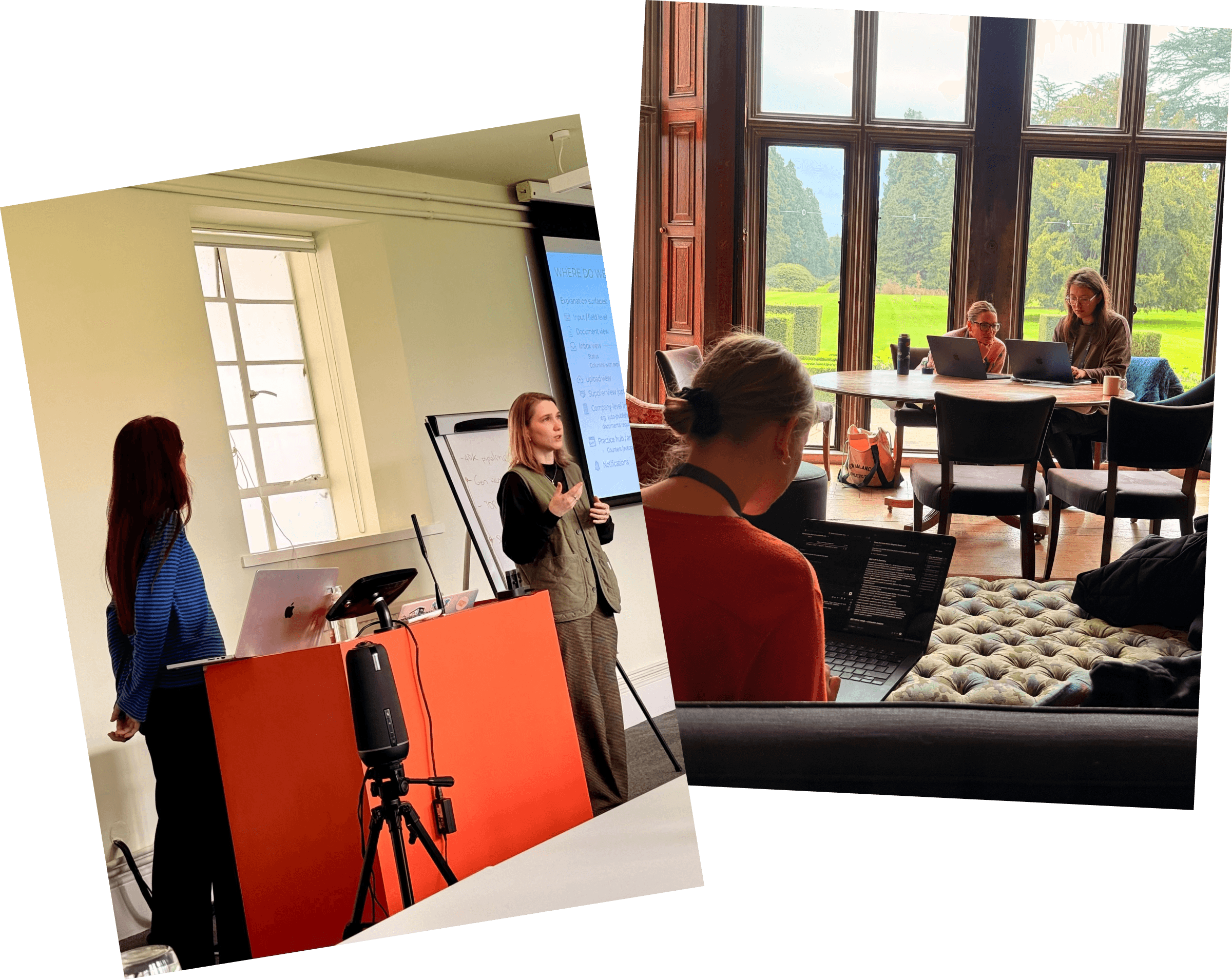
Defining structure at the Ashridge offsite
Achieving rapid progress required absolute clarity on product design and user experience. To establish this foundation, the team gathered for an intensive product offsite at Ashridge.
During this session, Senior Product Designer Tallulah Watson worked alongside the team to map out the complete core architecture and user interface. The entire structural blueprint for features like Teach William was established during this offsite, providing a clear design framework that the engineering team then built out in just two to three weeks.
To maintain momentum across complex design challenges, we adopted a split-team structure. Specialised sub-teams focused on dedicated areas of the product experience. For instance, Tallulah worked directly alongside Apron’s own Machine Learning expert Iana Ulianenko to solve the core challenge of ensuring William’s reasoning was always clear, transparent, and jargon-free.
Teaching William to adapt
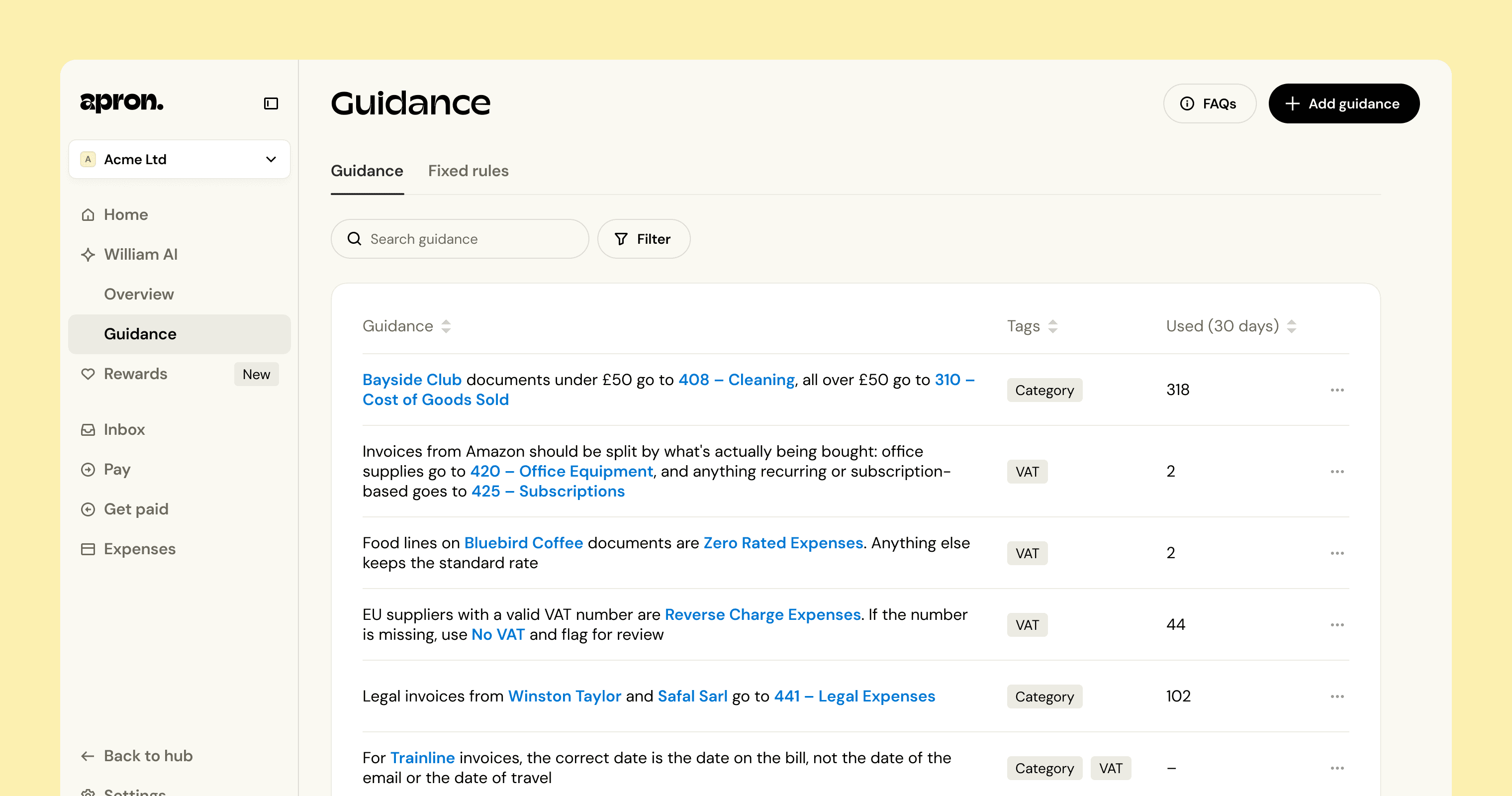
A central deliverable of this sprint was Guidance. While conventional bookkeeping tools rely on rigid, fixed rules, William learns dynamically from natural language feedback and historical Chart of Accounts data.
Accountants and bookkeepers can write guidance for client's companies using plain English..
For firms adopting this guidance framework, corrections dropped by 5x. Because William retains this knowledge, it effectively becomes tailored to the specific accounting practices of each firm, acting like an added team member that scales firm capacity without increasing overheads.
Looking ahead
Building Teach William and pushing precision to 99.9% in six weeks proved what is possible in the agentic bookkeeping space.
By pairing deep machine learning with thoughtful design, we have laid the foundation for a truly autonomous financial assistant. If our team can build a reliable, high-precision agentic workflow in a month and a half, the possibilities for what William AI will achieve over the next six months to a year are immense.