How Apron is making the agentic bookkeeping team member a reality with William AI
Designed for trust, built for scale

AI is moving from tools that assist with bookkeeping to agents that can actually do the work. For bookkeepers, the difference is software that reads your documents to software that handles repetitive work so you can focus on what actually needs your expertise.
William AI is built on that foundation. It searches connected inboxes for missing receipts, categorises documents based on guidance you've provided, then either publishes to your ledger or flags the item for review, explaining its reasoning at every step.
Trusting software with that level of judgment is a significant ask for firms and business owners. This series of blog posts explores how Apron built William AI from an extraction tool into a fully-fledged AI team member… and where the work is going.
One solution that does more
Bookkeepers and business owners don’t need another standalone app or a generic chatbot. They need fewer tools that do significantly more work. They need a system that closes the gap between the moment money is spent and the moment it’s reconciled across their ledger.
None of them trained for years and became certified and chartered, just to spend all day chasing receipts and updating spreadsheets.
That’s why Apron exists, and why we built William AI, which goes far beyond basic OCR data extraction. It autonomously searches connected client inboxes (Gmail or Outlook) for missing invoices and receipts, extracts data, categorises transactions based on firm-specific guidance, and publishes them straight to Xero or QuickBooks with plain-English explanations for every decision it makes.
Bringing William AI to every Apron user
Previously, William AI was a gated feature, accessible only to accounting firms on the Silver tier and above within Apron’s Books Club programme.
However, as William AI rapidly evolved from a promising prototype into an essential everyday team member, we recognised a clear disconnect: firms and business owners shouldn’t have to choose between basic invoice capture and frontier payments and bookkeeping AI.
Aligned with updates to our pricing model, we made William AI available to all Apron users. Our goal is to make agentic bookkeeping available as a standard part of Apron, rather than a premium add-on.
The William AI blog series
To pull back the curtain on how we built, refined, and scaled an autonomous bookkeeping agent, we published a four-part deep dive into the engineering, design, and vision behind William AI. Here is a look inside the series:
1. Designed for Trust: How William AI Works
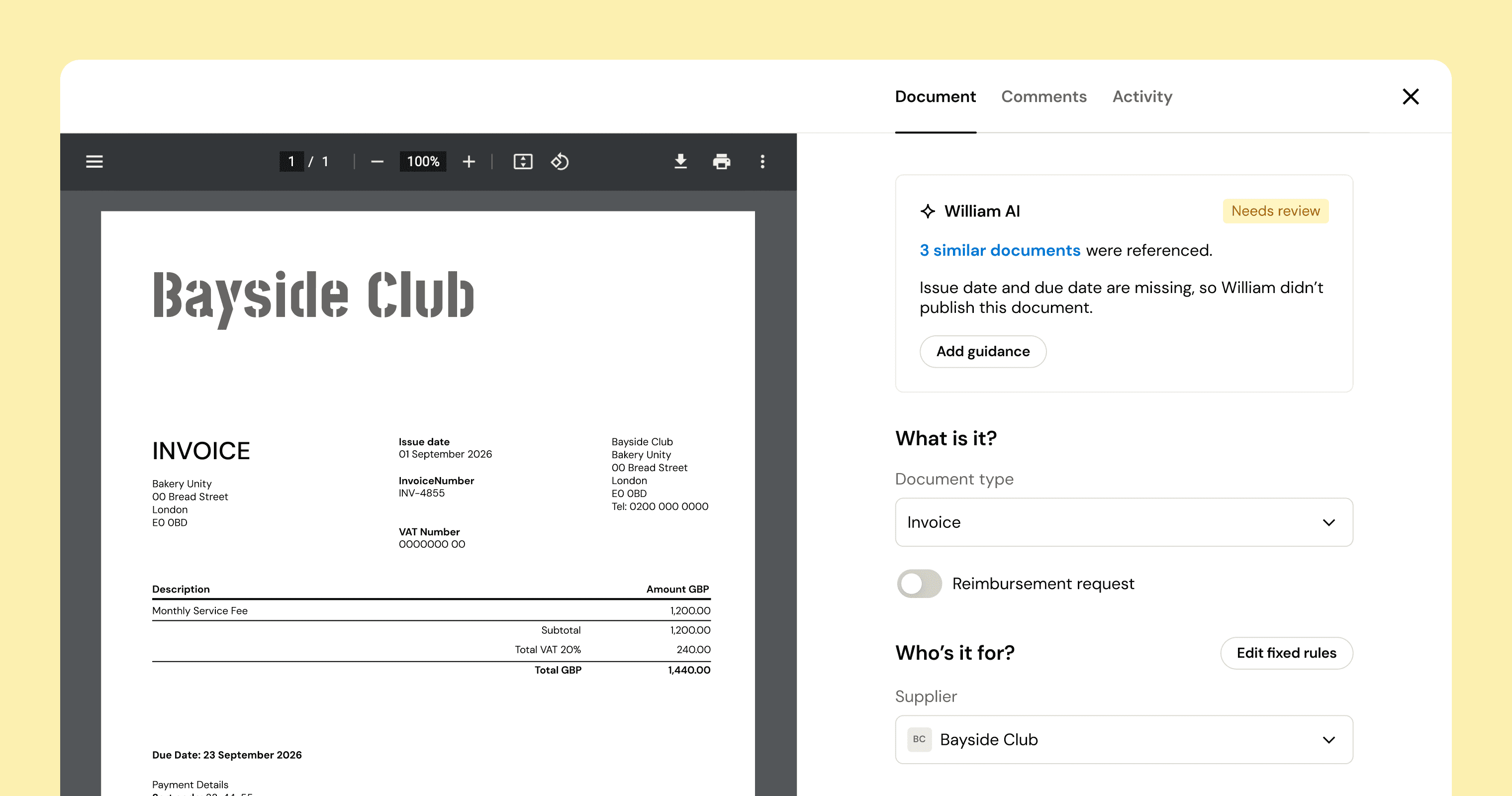
This post explores the core mechanics of William AI and how we designed a system that gives bookkeepers and accountants complete visibility and control over autonomous workflows.
From autonomous document retrieval in client inboxes to auto-publishing transactions straight to Xero or QuickBooks, William backs up every decision with clear, jargon-free reasoning.
When William is 100% confident, it auto-publishes; when it is uncertain, it flags the item for human review.
2. William AI Continues to Evolve: From Teach William to Guidance
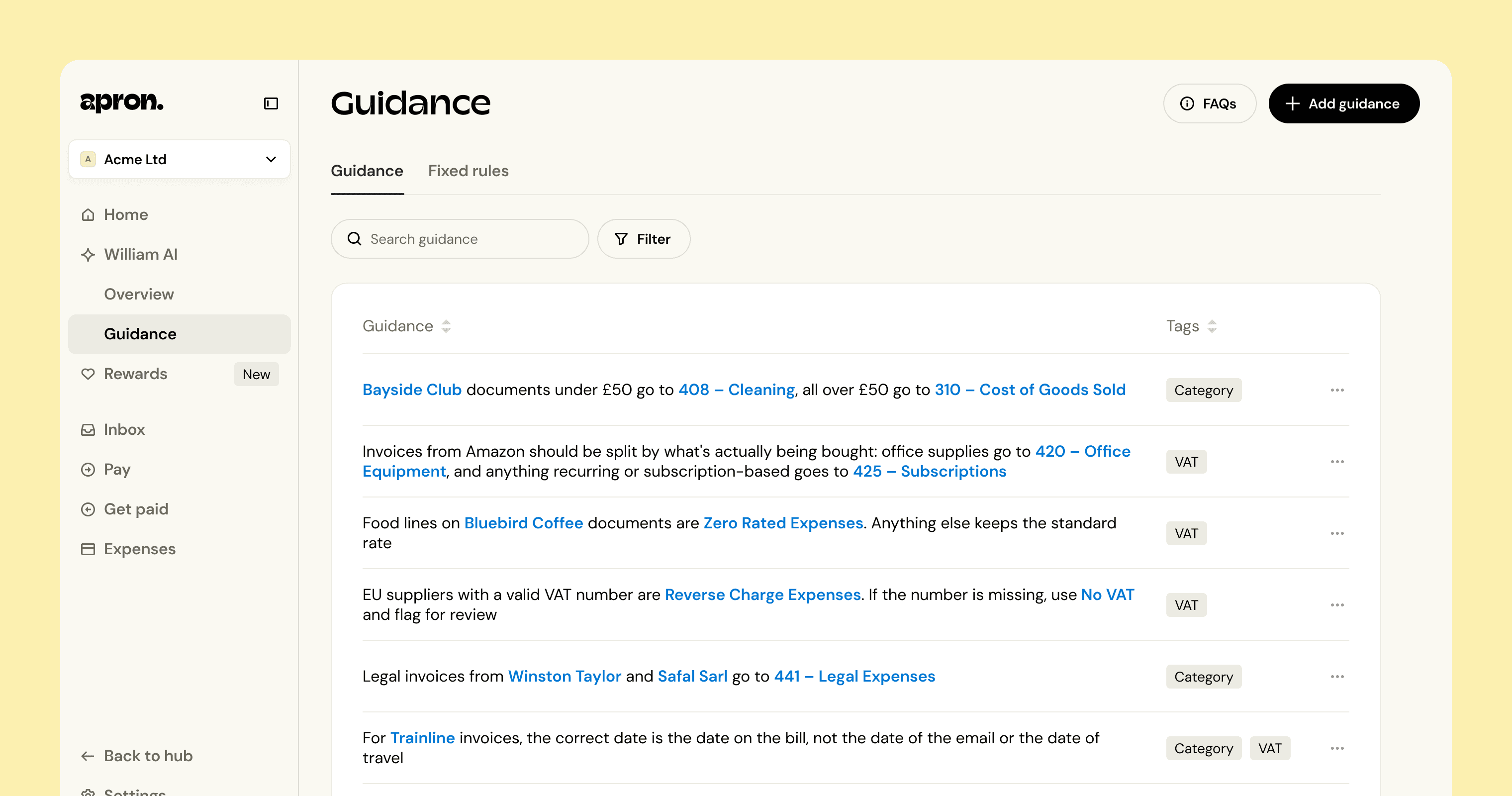
Conventional bookkeeping rules are rigid and break down the moment a supplier covers multiple purchase categories. In this post, we trace William’s transformation from static, supplier-level rules ("Teach William") to dynamic natural language "Guidance".
Instead of programming software, bookkeepers can instruct William using plain English, just as they would coach a junior staff member.
William proactively spots repeating manual corrections, suggests ready-made rules, and links every suggestion directly back to source documents showing its reasoning.
3. To 99% Accuracy in Six Weeks: Building William AI
Achieving near-perfect accuracy is non-negotiable when auto-publishing financial data. This article goes behind the scenes with Apron’s product and engineering teams to show how we took William AI from an ambitious prototype to a 99.9% precision rate on auto-published items in just six weeks.
By pairing an in-house machine learning model with a rigorous safety guardrail system featuring over 20 distinct validation checks, the team built a framework where roughly half of all incoming documents process entirely automatically. Learn how rapid sprint architecture, cross-functional collaboration, and dedicated design offsites laid the bedrock for true agentic bookkeeping.

4. How William AI Is Leading the Way in AI Bookkeeping
When you’re pioneering a new category, there is no existing blueprint to copy. This post details how Apron set out to define the market standard for agentic bookkeeping from scratch. By avoiding interface clutter, focusing on radical transparency, and co-designing directly alongside bookkeepers and accounting professionals, Apron has built an AI agent that adapts to real-world practice workflows.
The future of bookkeeping is here
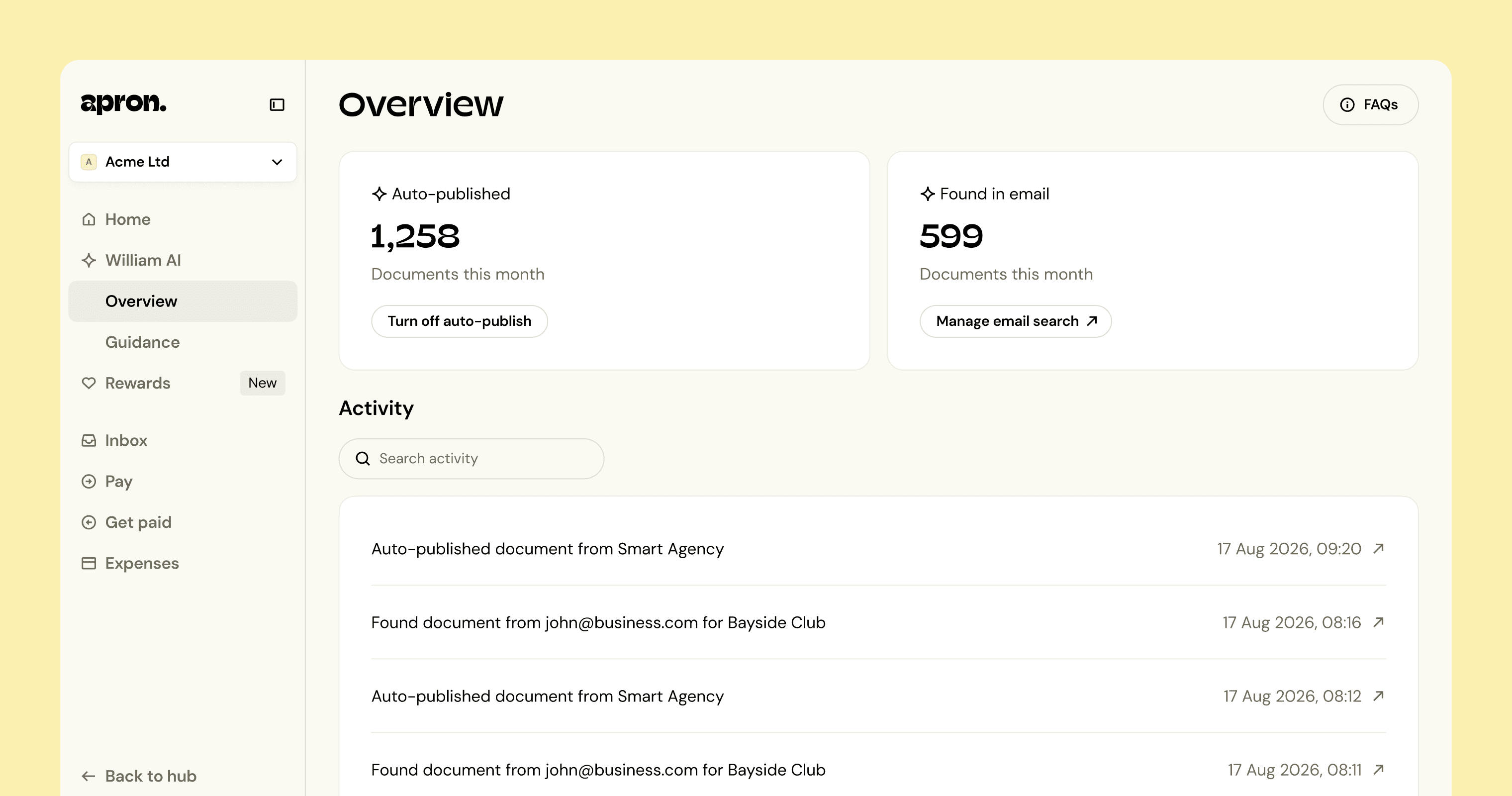
William AI is changing what bookkeeping software can take care of; from finding missing documents to categorising transactions and explaining its decisions. And this is just the beginning.
Get started with Apron today.